


Views: 0 Author: Site Editor Publish Time: 2026-06-02 Origin: Site


Accurate power measurement in commercial and industrial settings is not just a regulatory requirement. It is a critical safeguard against revenue leakage and operational inefficiency. Facilities running heavy machinery or managing multi-tenant billing need precise, reliable data. When you manage complex HVAC systems or heavy factory loads, upgrading to robust digital metering becomes a foundational operational decision. Relying on outdated electromechanical equipment masks severe power quality issues. It artificially inflates monthly utility expenses. Facility managers must capture every single kilowatt-hour.
This guide breaks down the core evaluation criteria for commercial-grade power measurement. We use the DTS986 digital metering architecture as a reliable industry benchmark. You will learn how to balance measurement precision, system integration, and environmental durability. By the end, you will understand exactly how to specify and deploy these systems. You will learn to protect your facility from hidden electrical losses effectively.
Capacity Overlap: Transitioning from a single-phase system to a three-phase digital meter is necessary when operational loads exceed 100A or require 380V distribution.
Technical Benchmarks: Commercial viability requires minimum Class 1.0 accuracy, wide-temperature tolerance (-25℃ to 70℃), and standardized form factors like a 35mm DIN rail mount.
Integration Readiness: Evaluating a meter requires looking beyond the hardware to its communication protocols (RS485/Modbus) and assessing if standard digital models suffice or if utility-grade standards are needed.
Risk Mitigation: Proper installation logic—specifically accurate Current Transformer (CT) matching and phase alignment—is critical to avoiding skewed billing data and phase imbalance hazards.
Inadequate electrical measurement costs large businesses substantial amounts of money every year. Relying on legacy electromechanical meters often leads to hidden electrical losses. Older mechanical units degrade steadily over time. They fail to register subtle power flows accurately. Furthermore, older units completely miss harmonic distortions generated by modern Variable Frequency Drives (VFDs). Improper phase setups frequently cause unbilled electricity usage in large tenant buildings. Industrial operators face similar revenue risks daily. Hidden energy drains compound over many months. They ultimately create massive billing discrepancies across your operations.
Facility managers must clearly understand their physical electrical limits. A traditional single phase energy meter serves strictly for light residential applications. You might also deploy it for isolated, low-load office circuits running on standard 220V power. Commercial facilities require far more robust infrastructure. Heavy industrial motors, massive commercial compressors, and complex distribution boards pull immense power constantly. These demanding setups dictate a 3x220/380V three-phase architecture. This specific approach balances heavy electrical loads across three separate lines. It prevents localized system stress and stops dangerous cable overheating.
Procurement teams need to establish clear success criteria before buying new hardware. A successful metering upgrade delivers verifiable Class 1.0 measurement accuracy. It also provides standardized digital data outputs for centralized Energy Management Systems (EMS). Modern upgrades must feature tamper-evident housings to block revenue theft actively. By prioritizing these exact benchmarks, you protect ongoing operational continuity and ensure reliable data capture.
Evaluating new hardware means examining accuracy and compliance standards deeply. Industrial facilities require IEC-compliant Class 1.0 accuracy for active energy tracking. High-load factory environments demand absolutely consistent precision under stress. Statutory calibration cycles strongly dictate long-term stability requirements for your devices. For instance, specific European jurisdictions mandate standard eight-year calibration limits for static digital measurement units. High-quality solid-state components resist thermal drift naturally. They ensure compliance throughout this entire statutory lifecycle without expensive interim testing.
Load capacity dictates your primary electrical connection type. Engineers utilize two main integration pathways for commercial boards.
Direct Connection: Technicians use this straightforward method for continuous electrical loads remaining under 100A. The main facility power runs straight through the internal meter terminals.
CT (Current Transformer) Integration: Heavy industrial facility loads easily exceed 100A. You must step down this massive current to ensure safety. A current transformer scales the incoming current down drastically. The meter microprocessor can then measure it safely and multiply the result mathematically.
Industrial electronics face punishing conditions daily. Environmental durability remains absolutely non-negotiable for commercial deployments. High-quality meters utilize specialized flame-retardant enclosures made from UL94 V-0 rated polycarbonate. They operate flawlessly across wide temperature ranges, typically functioning from -25℃ to +70℃. Factories generate intense ambient heat near processing lines. Outdoor enclosure cabinets suffer freezing temperatures at night. Wide thermal tolerance prevents hidden measurement errors caused by sudden internal component contraction.
Panel space is an incredibly valuable asset inside control rooms. Facility managers heavily prioritize modular component designs. Installing a standardized DIN rail KWh meter significantly optimizes high-density distribution panels. The slim 35mm profile conserves essential physical space inside the electrical cabinet. It allows maintenance technicians to perform rapid hardware replacements during emergency outages.
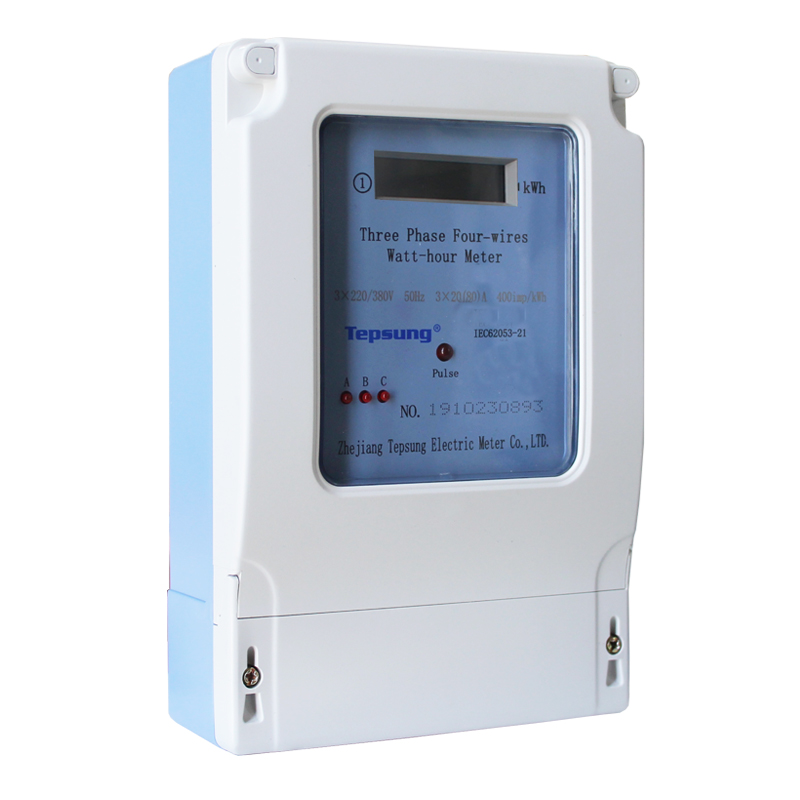
Hardware specifications define actual field capability. The DTS986 model serves as an excellent industry-standard benchmark for engineers. It operates on a robust three-phase four-wire architecture at 50Hz. The clear LCD digital readout provides instant local diagnostics for passing technicians. It cycles through active energy, reactive energy, voltage, and immediate current readings. Its low starting current triggers measurement at just 0.04% Ib. This extreme sensitivity ensures the hardware captures even the smallest energy draws during off-hours.
Commercial sub-metering setups require intense revenue protection logic. Anti-tampering features form a highly critical security layer. Built-in physical terminal cover seals prevent unauthorized wiring modifications mechanically. Advanced internal models detect reverse-current flow instantly. If someone attempts to bypass the primary measurement circuit, the internal system flags the energy anomaly. These physical and electronic safeguards eliminate the most typical commercial theft avenues.
Data communication capabilities dictate system integration success globally. Standard RS485 and Modbus RTU configurations dominate the industrial market. They connect effortlessly into localized Building Management Systems (BMS). Energy managers extract real-time voltage and amperage data consistently. They use this intelligence to optimize daily factory operations and track peak demand shifts.
Sometimes a standard model needs specific commercial modification. You must contextualize your upgrade paths carefully. When commercial properties require automated tenant revenue collection, developers specify a secure STS prepaid meter. These advanced units cut power automatically when digital token credits run out. Conversely, complex utility-level grid integrations demand highly standardized communication rules. They require a fully protocol-agnostic DLMS smart meter. These advanced units handle sophisticated remote load profiling securely over modern cellular networks.
Quality hardware is only as reliable as its physical installation. Electricians must follow strict wiring protocols for three-phase four-wire setups. Technicians always start by verifying complete power isolation via Lockout/Tagout (LOTO) procedures. They sequence the heavy ingress cables precisely. They route L1, L2, and L3 strictly into their designated phase terminals. Neutral alignment follows immediately to stabilize the critical reference voltage. Finally, they terminate the heavy load connections safely. Skipping these exact steps invites dangerous arc flashes or immediate component destruction.
Current Transformer mismatch represents the most common implementation failure globally. Pairing a commercial measurement unit with an incorrectly rated CT breaks the entire system. A mismatched multiplier ratio mathematically skews every single kilowatt-hour reading permanently. If you scale an 800A load using a 400A configuration profile, your billing data becomes entirely useless. You will underbill tenants severely and distort your facility energy reports.
Industrial motors face constant phase imbalance risks daily. Uneven electrical loads across L1, L2, and L3 create excessive, damaging heat. Facility managers monitor power factor and harmonic data directly from these advanced digital displays. They identify slight, emerging phase imbalances early. Correcting these subtle imbalances promptly prevents catastrophic damage to expensive downstream industrial equipment.
We strongly recommend a rigorous commissioning process for every installation. Technicians should follow a structured post-installation validation checklist strictly.
Verify complete power isolation before closing any distribution panels.
Check every terminal screw torque specification to prevent dangerous micro-arcing.
Validate the LED pulse output frequency visually. Ensure 400 imp/kWh accurately matches the physical load draw.
Establish clear data communication handshakes between the installed hardware and your centralized software via RS485 lines.
Selecting the right model requires matching the hardware strictly to your facility profile. Different industrial environments demand highly specific electrical features. You cannot use a universal approach when specifying high-voltage analytical electronics.
Property managers handle vast multi-tenant environments daily. They must prioritize high readability through brightly backlit LCD screens. Tight tenant electrical panels heavily require standard DIN-rail mounting configurations. Tamper-proof polycarbonate enclosures protect vital revenue streams from malicious physical interference.
Industrial workshops run continuous shift-based operations. They need heavy-duty terminal blocks to handle regular thermal cycling safely. Direct 100A capacity wiring easily manages medium-sized industrial lathes and commercial compressors. Basic Modbus integration allows plant managers to allocate energy costs accurately across different daily production shifts.
Large industrial factories demand maximum electrical resilience. High-accuracy CT-operated configurations measure massive electrical currents safely and accurately. Heavy stamping machines cause severe physical tremors throughout the facility. Robust structural vibration resistance keeps internal circuit boards perfectly intact. Deep power quality analytics, like reactive power and power factor tracking, optimize massive induction motor performance.
Facility Type | Primary Requirement | Typical Connection | Key Feature Focus |
|---|---|---|---|
Commercial Sub-Metering | Revenue Protection & Space Optimization | Direct (sub-100A) | Tamper-proof, DIN-rail, Backlit LCD |
Light Manufacturing | Cost Allocation per Production Shift | Direct (up to 100A) | Modbus Integration, Heavy Terminals |
Heavy Industrial | Power Analytics & High Load Safety | CT Connection (1.5/6A) | Power Factor Tracking, Vibration Resistance |
Choosing a modern three phase energy meter like the DTS986 requires technical precision. You must align exact voltage and current specifications with your physical panel constraints strictly. Consider your long-term digital data integration goals very carefully. Mismatched measuring hardware compromises both facility safety and tenant billing accuracy. A well-planned hardware upgrade mitigates hidden electrical losses and streamlines complex facility operations safely.
Procurement teams need to execute specific, actionable next steps immediately. First, audit your current maximum electrical load requirements across all distribution boards. Second, verify required software communication protocols. Choose between Modbus or DLMS in direct consultation with your chosen software integrators. Finally, request detailed manufacturer technical datasheets. Secure physical sample units for comprehensive pilot testing prior to authorizing any bulk deployment across your enterprise.
A: Direct connection routes the full electrical load straight through the meter. Manufacturers usually cap this at 100A. A CT connection relies on transformers to scale down massive currents, like 800A, to a safely measurable baseline of 1.5(6)A. This prevents the meter from burning out under heavy industrial loads.
A: You must verify if your specific DTS986 model supports bi-directional logic. Bi-directional models measure both grid consumption and solar energy export accurately. If the standard model only reads forward active energy, you must specify a distinctly bi-directional variant designed specifically for renewable energy setups.
A: Calibration frequency depends on local statutory regulations. Regions typically mandate calibration cycles ranging from eight to ten years for commercial models. Static digital components feature high drift-resistance. They outlast older electromechanical wheels, retaining their Class 1.0 accuracy over longer continuous operational periods without constant recalibration.


