


Views: 0 Author: Site Editor Publish Time: 2026-06-01 Origin: Site


Accurate energy measurement in residential applications represents a critical infrastructure requirement today. Modern apartments, multi-tenant housing, and solar-equipped homes rely on precise power data. Property owners need this data for fair billing, effective load management, and strict grid compliance. Selecting the right hardware often creates significant evaluation challenges. You must balance upfront hardware limitations against long-term operational reliability. We also have to meet complex compliance standards and handle strict system integration requirements. Defaulting to oversized equipment wastes budgets, while undersizing creates dangerous safety hazards.
This guide offers a rigorous framework tailored for electrical contractors, property managers, and system integrators. You will learn how to specify digital electrical meters accurately. We explore practical load profiles, evaluate physical installation constraints, and clarify modern connectivity needs. Read on to master residential energy hardware selection and avoid costly field errors.
Load Thresholds: A single-phase setup is optimal for residential loads typically under 10kW–15kW; exceeding this or adding heavy inductive loads necessitates a three-phase alternative.
Accuracy Standards: Class 1.0 accuracy (±1% error margin) is the global standard for residential revenue-grade billing.
Physical Integration: A DIN rail KWh meter minimizes footprint in residential consumer units, with standardized module widths (18mm per module) driving selection.
Application Specifics: Smart energy meters with bi-directional capabilities are mandatory for solar homes, while STS prepaid meters provide secure revenue protection for tenant sub-metering.
Defining the baseline electrical load dictates your entire hardware strategy. Standard residential units operate on 220V or 230V networks. For these typical applications, a single phase energy meter efficiently handles total power draws up to 10kW. This capacity covers everyday household appliances, standard lighting arrays, and basic climate control systems. When calculating the electrical demand, engineers usually translate this 10kW limit into a 40A to 100A current range. Staying within this specific bracket ensures safe, continuous operation without stressing internal measurement shunts.
Certain residential setups exceed standard operational limits quickly. You must identify specific trigger points requiring an upgrade to a three phase energy meter. Look for properties running central HVAC chillers or large swimming pool pumps. High-capacity Level 2 or Level 3 electric vehicle (EV) chargers also demand three-phase power. These heavy inductive loads draw massive starting currents. A three-phase architecture distributes this heavy load across three distinct live wires. This prevents dangerous voltage drops and protects the local distribution grid.
Defaulting to three-phase equipment for every standard home introduces unnecessary hardware complexity. Three-phase meters occupy more physical space in distribution boards. They also demand complex field wiring configurations. Using standard equipment for standard loads keeps panel layouts clean and minimizes installation risks. Over-engineering residential sub-panels rarely yields measurable operational benefits. You should reserve complex three-phase systems exclusively for homes exhibiting industrial-level power demands.
Most residential setups rely exclusively on direct-connect metering. In these setups, the main power cables physically route through the meter terminals. You will typically specify ratings like 5(40)A or 5(100)A. The first number represents the base measuring current. The number inside parentheses indicates the absolute maximum safe current.
If a rare residential load exceeds 100A, you cannot safely route cables directly through the device. This scenario requires Current Transformer (CT) integration. A CT-operated meter utilizes external sensors to step down the current safely. You might see a specification like 1.5(6)A for these units. However, CT integrations remain exceptionally rare in single-family residential projects.
Regulatory compliance defines the legitimacy of any billing meter. You must adhere to the IEC 62053 international standards for electrical measurement. For residential revenue-grade billing, always specify Class 1.0 accuracy. This classification guarantees an error margin of no more than ±1% under standard conditions.
Avoid the common mistake of over-specifying hardware. Demanding Class 0.2S or Class 0.5S accuracy introduces unwarranted hardware complexity. Manufacturers design these ultra-precise instruments for heavy industrial substations. Using them in residential sub-metering wastes resources without improving tenant billing fairness.
Digital meters offer varying levels of data granularity. The chart below differentiates basic tracking from advanced parameter monitoring.
Parameter Capability | Tracked Metrics | Best Residential Application |
|---|---|---|
Basic Active Energy | kWh (Kilowatt-hours) only | Standard tenant billing and simple sub-metering. |
Multi-Parameter Tracking | kWh, Voltage (V), Current (I) | Grid stability monitoring and fault diagnostics. |
Advanced Power Quality | Active/Reactive Power, Power Factor (PF) | Solar-equipped homes and heavy inductive load monitoring. |
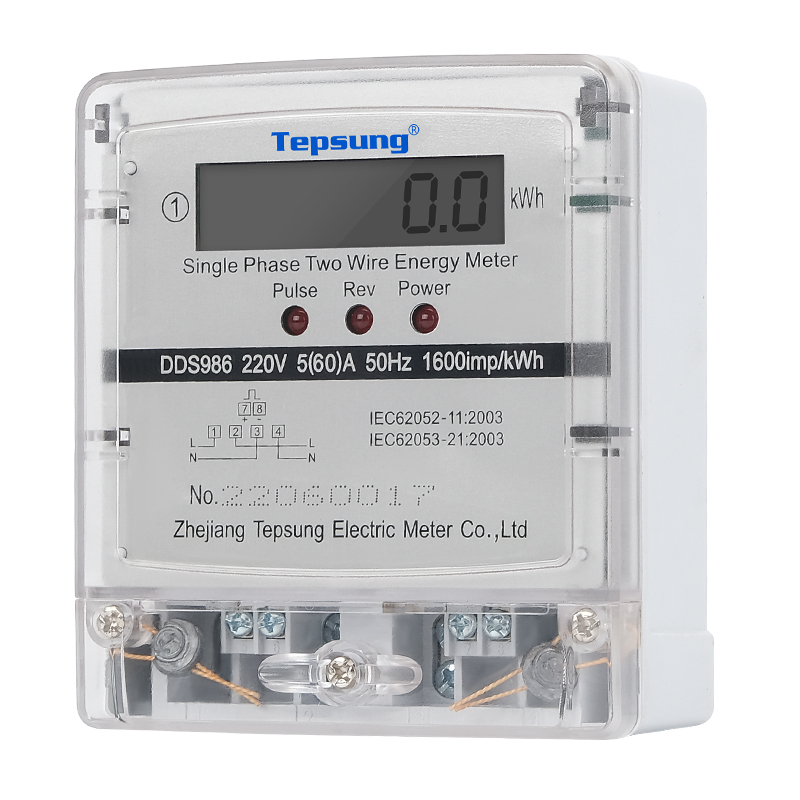
Physical space remains a premium commodity inside residential consumer units. This constraint explains why a DIN rail KWh meter serves as the default choice for modern sub-panels. The DIN rail system standardizes equipment mounting globally. Equipment width is measured in standardized modules, where one module equals 18mm.
When planning panel space, you must calculate these module widths accurately. A basic digital meter often occupies two modules (36mm). More advanced units requiring larger LCDs might occupy four modules (72mm). This modular design allows contractors to snap devices securely onto the metal rail alongside standard circuit breakers.
You may encounter panel-mounted alternatives during hardware evaluation. These bulky units require specialized cutout holes on the enclosure door. Engineers generally reserve panel mounts for main building distribution boards. They provide larger local displays for facility managers. For standard residential sub-panels, panel mounts simply consume too much vertical space.
Even premium hardware fails if field execution falls short. Based on extensive field experience, installers frequently encounter specific implementation risks. Watch out for these common mistakes:
Incorrect Voltage Reference Wiring: Reversing live and neutral connections corrupts digital metrology algorithms, leading to vastly inaccurate billing data.
Over-Torquing Terminal Screws: Applying excessive force crushes stranded copper wires. This reduces surface contact area and causes micro-arcing. Micro-arcing eventually melts the terminal block.
Ignoring Environmental Limits: Most standard units operate safely between -10°C and +55°C. Placing consumer units on exterior walls exposed to direct desert sunlight degrades LCD screens rapidly.
Rooftop solar photovoltaics completely change how residential loads behave. Homes generating internal power require specialized measurement capabilities. You must install a smart energy meter offering bi-directional tracking. Legacy hardware only spins forward, meaning exported solar energy falsely registers as consumed grid energy.
Bi-directional capabilities solve this critical flaw. The device maintains two independent data logs. It tracks imported utility energy in one register. It simultaneously logs exported solar energy in a second register. This precise separation enables fair net-metering tariffs.
Multi-tenant properties face unique revenue collection challenges. Landlords frequently battle delayed payments and bad debt. Integrating an STS prepaid meter provides absolute revenue protection. STS stands for Standard Transfer Specification. This global protocol uses cryptographic tokens to manage energy credits.
Tenants purchase a 20-digit numeric token via mobile apps or local vendors. They punch this code into the device keypad. The meter decrypts the code and allocates the exact kWh value. Once credits deplete, an internal relay disconnects power automatically. This eliminates bad debt entirely. It also streamlines landlord administration because token generation operates offline without constant network dependency.
When selecting smart features, matching the communication protocol to the building layout ensures reliable data flow. Here is how to evaluate the primary protocols:
RS485 (Modbus-RTU): This hardwired protocol provides unmatched stability. It works best for large apartment blocks. You can daisy-chain dozens of devices along a single shielded twisted-pair cable.
Wi-Fi and IoT Connectivity: Wireless protocols eliminate complex cable runs. They excel in single-home integrations. Homeowners can link their data directly to cloud-based Residential Energy Management Systems (REMS).
LoRaWAN: This low-power, long-range protocol serves sprawling residential communities well. It penetrates concrete walls better than standard Wi-Fi.
Contractors value hardware that adapts to unpredictable site conditions quickly. Easy local configuration dramatically reduces contractor callback rates. When evaluating vendors, investigate their software interfaces carefully. You need devices that allow installers to modify parameters directly via front-panel buttons or Bluetooth apps.
Pulse output adjustment serves as a prime example. Data loggers often require specific pulse rates to calculate consumption. A flexible device lets you set the pulse output to 800 imp/kWh or 1000 imp/kWh on demand. Similarly, field technicians should be able to adjust RS485 communication baud rates locally. If an existing building network runs at 9600 bps, locking a new device at 2400 bps causes instant integration failure.
Digital metering components face constant electrical stress. However, well-engineered solid-state technology outlasts legacy mechanical spinning disks. You should set realistic expectations for hardware longevity. A premium digital unit typically delivers 10 to 15 years of flawless operation before component drift affects accuracy.
Do not compromise on regional certifications. Certifications provide absolute liability protection against electrical fires or billing disputes. Evaluate your geographical requirements strictly. European deployments demand MID (Measuring Instruments Directive) certification for legal commercial billing. North American installations require UL listing to pass municipal fire inspections. CE marking remains a non-negotiable baseline for general safety compliance globally. Reject uncertified equipment immediately, regardless of its technical specifications.
Specifying the correct residential energy hardware requires a systematic approach. You must match the base electrical load carefully. Direct-connect hardware under 100A covers almost all standard housing needs. Align the physical form factor by selecting standardized DIN rail modules to save panel space. Finally, specify connectivity based entirely on the end-user profile. Use cryptographic STS protocols for tenant scenarios and mandate bi-directional capabilities for solar-equipped homes.
Before requesting vendor datasheets, you should audit your available panel space carefully. Calculate your peak residential load accurately. Use the takeaways below to finalize your hardware requirements.
Audit existing consumer units to count available 18mm DIN rail modules.
Calculate peak potential load to confirm if a standard 10kW direct-connect unit suffices.
Determine if the property plans to add rooftop solar within the next five years.
Verify local regulatory requirements to ensure requested hardware carries CE, UL, or MID certifications.
A: A sub-meter is simply a specific application of an energy meter. You install a single-phase DIN rail unit downstream from the main utility provider's master meter. Property managers use these downstream sub-meters strictly for internal cost allocation among specific tenants or specific heavily loaded circuits.
A: Yes, it can measure solar generation perfectly. However, the device must be explicitly rated for bi-directional energy measurement. Bi-directional models utilize dual internal registers to separate imported utility energy from exported solar energy, making net metering possible.
A: Digital solid-state meters rarely require manual recalibration. They typically maintain their strict Class 1.0 accuracy throughout their entire 10-to-15-year lifespan. This low-maintenance profile gives them a massive operational advantage over legacy mechanical meters, which suffer from physical friction wear.
A: No. Core metrology relies on internal microprocessors. The device continues to measure, calculate, and log energy data accurately offline. While remote dashboard reporting pauses during internet outages, local LCD readings and offline STS token decrypting continue functioning normally.


