


Views: 0 Author: Site Editor Publish Time: 2026-10-05 Origin: Site


The cryptographic limitation built into the Standard Transfer Specification (STS) framework forces a hard stop for legacy token acceptance. Tied to the November 24, 2024 global deadline, this event requires immediate intervention from utility operators and property managers. The foundational architecture of these payment systems relies on a time-based identifier rapidly approaching its maximum numerical value. Once this threshold is crossed, the system can no longer distinguish between new credit and old, previously used codes.
Failure to execute the Token Identifier (TID) rollover before the base date expires results in widespread token rejection. This operational failure triggers immediate revenue leakage, massive increases in support desk volume, and severe disruptions to end-user power supply. Successfully navigating this transition requires a systematic approach to generating, distributing, and inputting Key Change Tokens (KCTs). This guide provides a technical checklist for executing the rollover and standardizing troubleshooting protocols across utility networks.
All legacy STS meters require a two-part, 40-digit Key Change Token (KCT) sequence to reset the TID memory and update the cryptographic base date.
Any previously purchased, unused electricity tokens must be loaded into the meter *before* initiating the KCT sequence, as they will be permanently invalidated post-rollover.
Utility operators must evaluate their vending system readiness to ensure software is capable of generating rollover-compliant tokens across multiple retrieval channels (receipts, SMS, USSD) without disrupting daily revenue collection.
Standardizing STS token troubleshooting protocols—especially for complex installations like an STS three-phase prepaid meter—is critical to minimizing technician dispatch costs during the transition.
Understanding the technical necessity of the TID rollover requires examining the underlying architecture of the Standard Transfer Specification. Every time a user purchases electricity, the vending system generates a unique 20-digit token. Embedded within this token is a 24-bit Token Identifier (TID). This identifier calculates the exact number of minutes that have elapsed since the original base date of January 1, 1993. The meter uses this minute-value to prevent replay attacks. If a user attempts to enter a token with a TID value older than or equal to one already processed, the meter rejects it. This mechanism ensures a token can only be used once.
The mathematical limitation of a 24-bit integer means it can only store a finite number of minutes. Specifically, the counter reaches its maximum capacity of 16,777,215 minutes after approximately 31.9 years. This maximum value aligns with November 24, 2024. Once the counter exceeds this limit, it rolls over back to zero. A standard STS prepaid meter operating on the 1993 base date will interpret any new token generated after the rollover as an old, previously used token because the new minute-value will be smaller than the last recorded value in the meter's memory. Consequently, the hardware rejects all new credit.
To prevent this grid-wide failure, the cryptographic base date must be updated from 1993 to 2014. This shift resets the minute counter, extending the lifespan of the token acceptance capabilities for another three decades. The update process involves modifying the supply group code (SGC) and the tariff index stored within the non-volatile memory. The rollover bit must be set within the internal processor. This specific bit signals to the firmware that it should now reference the 2014 base date when decrypting and validating incoming tokens.
Utility-wide compliance metrics must be established long before the deadline approaches. Operators need to define the baseline requirements for a successful rollout. A primary metric is achieving zero unplanned downtime during the transition phase. Utilities must aim for 100% meter reachability, ensuring every active endpoint receives the necessary update codes. Verifiable audit trails are mandatory. The central vending database must accurately reflect which endpoints have successfully updated their cryptographic keys and which remain on the legacy base date, allowing for targeted follow-up interventions by field crews.
The physical execution of the rollover relies on the end-user or field technician correctly inputting a specific sequence of numbers. Before any new codes are entered, strict operational directives must be enforced regarding existing credit. End-users must input all un-entered credit tokens prior to initiating the update. The KCT sequence fundamentally alters how the firmware decrypts incoming data. Once the base date is shifted to 2014, any token generated under the 1993 base date becomes instantly and permanently invalid. Utilities face significant financial implications if users fail to follow this prerequisite. Orphaned tokens cannot be refunded or re-issued easily, leading to severe customer dissatisfaction and complex reconciliation processes at the municipal level.
Distributing the Key Change Tokens efficiently is a massive logistical challenge. End-users will access their specific KCTs through established vending channels. Automated distribution is the most viable method for large-scale networks. When a user makes their first electricity purchase after the utility activates the rollover protocol, the vending backend automatically generates the two required 20-digit KCTs alongside the standard credit token. These codes are printed sequentially on the purchase receipt. For digital transactions, the codes are sent via SMS or retrieved through utility-specific USSD codes on mobile devices. Clear labeling is mandatory to ensure the user understands the difference between the update codes and the credit code.
The standard KCT input process requires precision and patience. The procedure is universally standardized across all compliant hardware. Field technicians and end-users must follow these exact steps:
Input the first 20-digit KCT string into the keypad. This initial command instructs the processor to clear the existing TID memory stack and prepare for a new cryptographic key.
Wait for the hardware to process the first string. This mandatory pause usually takes three to five seconds. Watch the LCD screen for an "ACCEPT" message or listen for a confirmation chime.
Input the second 20-digit KCT string. This final command establishes the new cryptographic key, sets the rollover bit, and locks in the 2014 base date.
Input the newly purchased 20-digit credit token to verify the meter is successfully accepting 2014 base date credit.
Verification protocols provide immediate feedback to the person performing the update. Operators must educate users on the expected responses from their specific hardware models. Successful entry is typically confirmed by specific LED flash patterns, distinct LCD confirmation codes, or a recognizable acceptance chime. If the hardware displays an error code or emits a sustained rejection tone, the sequence has failed, and the rollover bit has not been set. Understanding these visual and auditory cues prevents users from mistakenly assuming the update was successful and walking away from a locked meter.
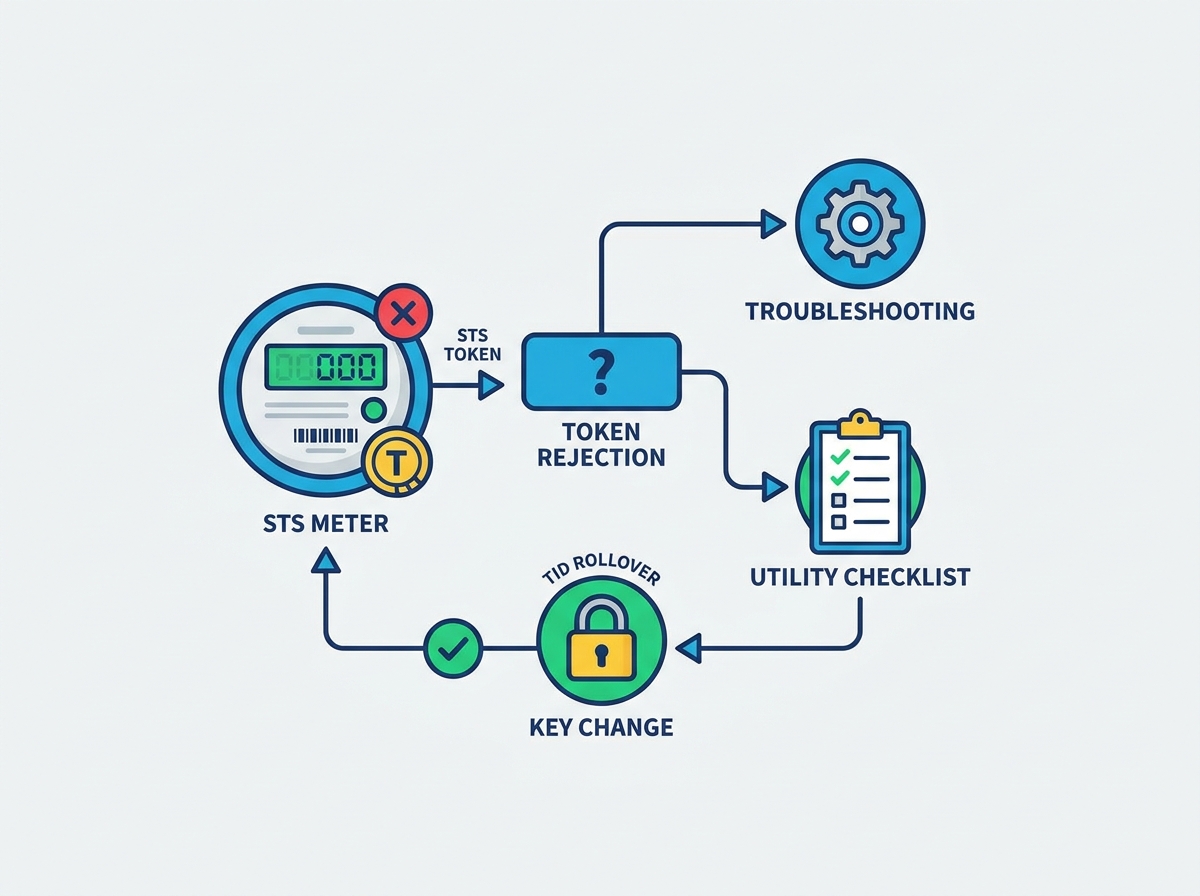
Even with clear instructions, errors during the manual input process are inevitable. Diagnosing "Meter Rejecting Token" errors requires a systematic decision tree to isolate the root cause post-rollover. When a user reports a rejection, the first check must verify the KCT sequence. Did the user enter the codes in the correct order? Reversing the first and second 20-digit strings guarantees a rejection. The second check involves meter number mismatch. Users managing multiple properties or living in shared housing often attempt to enter KCTs generated for a different endpoint. The cryptographic keys are hardcoded to a specific serial number; cross-pollination is impossible. Finally, verify if a standard credit token has already been used. If the user accidentally re-enters a successfully loaded credit token while attempting the update, the system flags a duplicate token error.
Effective STS token troubleshooting often comes down to resolving sequence and input timing issues. The physical constraints of keypad entry play a significant role. Older keypads suffer from contact degradation, causing missed digits or double entries. Entering digits too quickly overloads the processing buffer. Failing to pause between the two KCTs prevents the memory from clearing properly. Conversely, pausing too long between the first and second code triggers a timeout error. When a timeout occurs, the system resets to its previous state, requiring a full restart of the entire 40-digit sequence.
Complexities escalate when dealing with an STS three-phase prepaid meter. These units are typically installed in industrial settings, commercial buildings, or large residential properties with high load demands. The troubleshooting requirements for these setups involve additional variables. Often, the main measurement unit is secured in a locked kiosk or utility room, while the user interacts with a remote Customer Interface Unit (CIU) located inside the premises. Communication errors between the CIU and the main unit—often utilizing Power Line Carrier (PLC) or Radio Frequency (RF) technology—easily interrupt the KCT handshake. Phase imbalances or localized power dips during the exact moment of token entry corrupt the data packet transmission. Technicians must ensure stable communication and power quality before attempting the rollover sequence on these heavy-duty installations.
Common Post-Rollover Rejection Codes and Resolutions
Error Symptom / Display Code | Primary Cause | Actionable Resolution |
|---|---|---|
Reject 01 / "Used" | Token has already been successfully entered into the system. | Discard the token. Verify current credit balance. No further action needed. |
Reject 02 / "Old" | Attempting to enter a 1993 base date token after the KCT update. | Token is permanently invalid. Purchase new credit generated under the 2014 base date. |
Reject 04 / "Wrong Meter" | Token was generated for a different serial number. | Verify the serial number on the receipt matches the physical unit. Retrieve correct KCTs. |
Timeout / Screen Blank | Too much time elapsed between entering the first and second KCT. | Restart the entire process. Enter the first 20 digits, wait 3 seconds, enter the second 20 digits. |
CIU Comm Error (Three-Phase) | Interference disrupting the PLC or RF signal between the keypad and the main unit. | Plug the CIU directly into an outlet closer to the main distribution board. Eliminate noise sources like heavy motors. |
Keypad Unresponsive | Physical degradation of the membrane switch or dead internal battery. | Dispatch a field technician to replace the CIU or the entire meter head. |
Utility managers and municipalities face a massive logistical hurdle regarding how to deploy the update across their entire network. The solution categories generally fall into two primary deployment models: customer-led and technician-led. Each model carries distinct trade-offs regarding labor allocation, speed, and compliance rates. Selecting the appropriate strategy depends heavily on the utility's budget, the geographical spread of the network, and the technical literacy of the customer base.
The customer-led approach offers high scalability and low operational overhead. By automating the distribution of KCTs through existing vending channels, utilities push the labor of the update onto the end-user. This allows hundreds of thousands of endpoints to be updated simultaneously without deploying a single vehicle. However, this strategy carries a high risk of user error. A customer-led rollout guarantees increased call center volume as users struggle with keypad timing, lost receipts, or CIU pairing issues. A percentage of meters will remain un-updated if users stockpile credit and do not interact with the vending system before the deadline.
Conversely, a technician-led approach ensures high compliance and immediate verification. Field crews physically visit every endpoint, audit the hardware, and manually input the KCTs. This guarantees the rollover bit is set correctly and allows for on-the-spot troubleshooting of broken keypads or bypassed connections. The drawback is the massive labor expenditure and logistical overhead. For a utility managing a sprawling urban network, a purely technician-led rollout is often financially and practically impossible within the remaining timeframe. Most operators opt for a hybrid approach, relying on customer-led updates for the bulk of the residential grid while reserving field crews for industrial three-phase installations and unresponsive residential units.
Regardless of the chosen deployment model, vending system readiness and software compatibility are non-negotiable prerequisites. The backend vending software must be upgraded to support the 2014 base date generation. The system must be capable of automatically appending KCTs to a user's next purchase without requiring manual generation by the vendor at the point of sale. If a cashier has to manually request the update codes through a separate terminal interface, the queue times at physical vending stations will become unmanageable.
Scalability and revenue protection rely heavily on seamless API integrations between the STS Association's key management systems and local vending platforms. Different deployment strategies impact database load directly. If the vending API fails under the load of generating millions of KCTs simultaneously, revenue collection halts. Utilities must stress-test their database architecture and Hardware Security Modules (HSMs) to ensure they can handle the dual load of generating standard credit tokens alongside the complex cryptographic key changes without latency or timeouts.
Executing a network-wide cryptographic update exposes existing vulnerabilities within the physical infrastructure. Handling orphaned or tampered meters presents a significant implementation risk. During the rollover process, utilities will inevitably discover units that have been illegally bypassed. Because bypassed units do not require regular credit purchases, these users will never trigger the automated KCT generation. Similarly, units with broken keypads cannot receive the manual input required for the update. Utilities must outline a strict protocol for auditing these specific endpoints. Field teams must be dispatched to replace damaged hardware and rectify illegal connections before the deadline, or those endpoints will permanently drop off the manageable network.
Communication protocols for end-users form the backbone of a successful mitigation framework. The technical nature of the TID rollover easily causes confusion and panic among consumers who suddenly receive 60 digits on their receipt instead of the usual 20. Clear, multi-channel communication is an absolute necessity. Utilities must leverage specific outreach methods to educate the public:
Deploy automated SMS campaigns detailing the step-by-step input process.
Print visual guides and warning notices directly on monthly utility bills.
Host localized community outreach programs in high-density residential areas.
Distribute instructional videos across official social media platforms demonstrating the exact keypad timing.
Maintaining data integrity and establishing robust audit trails allows management to track the progress of the deployment. A centralized dashboard is required to monitor the network in real-time. This dashboard must cross-reference vending data with endpoint serial numbers to track which units have successfully rolled over versus those that are still operating on the legacy base date. Without this data integrity, utilities are flying blind. They will be unable to identify stalled deployment zones or target specific neighborhoods for technician intervention as the deadline approaches. The audit trail also provides critical documentation for regulatory compliance, proving that the utility took all necessary steps to secure the grid's revenue collection capabilities.
Initiate a pilot rollover program on a small, controlled subset of endpoints to monitor system behavior and API load in a live environment.
Audit your vending software providers immediately to confirm their backend systems support automated KCT generation without manual cashier intervention.
Finalize and distribute standardized troubleshooting documentation to all call center staff and field technicians to handle the inevitable surge in support tickets.
Launch a comprehensive, multi-channel public awareness campaign to educate end-users on the KCT input sequence and the strict prerequisite of loading old credit first.
Deploy field crews to audit and replace tampered meters or units with broken keypads, as these cannot be updated via customer-led initiatives.
A: A Key Change Token (KCT) consists of two unique 20-digit codes generated specifically for your meter's serial number. These codes are required to reset the internal Token Identifier (TID) memory and update the cryptographic base date from 1993 to 2014, allowing the hardware to continue accepting new electricity credit.
A: Rejections typically occur if unused older tokens were not loaded first, if the KCT sequence was entered incorrectly, or if you timed out during entry. Rejections also happen if you enter a duplicate token that has already been used, or if you attempt to load a token generated for a different meter serial number.
A: Existing credit already loaded onto the meter remains completely safe and will not be erased. However, any un-entered paper or SMS tokens purchased before the update will become permanently invalid if they are not loaded into the keypad before you enter the new KCT sequence.
A: You must wait a few seconds after entering the first 20 digits for the hardware to process the command and clear its memory. Watch for the screen to display an acceptance message or listen for a confirmation chime before immediately inputting the second set of 20 digits to avoid timeout errors.
A: The manual KCT input process is identical to single-phase units. However, you must ensure the remote Customer Interface Unit (CIU) has a stable, uninterrupted connection to the main measurement unit during the input process. Plug the CIU into an outlet close to the main distribution board to prevent communication failures.
A: If the update is not performed, the meter's internal memory will max out on November 24, 2024. The processor will view all newly generated tokens as old, previously used codes, rendering it incapable of accepting any new credit and effectively cutting off power once existing units deplete.
A: Standard legacy units require manual keypad entry by the user or a technician. However, advanced smart units connected to Advanced Metering Infrastructure (AMI) networks may support remote firmware updates, allowing the utility to push the base date change over the air without physical interaction.


