


Views: 0 Author: Site Editor Publish Time: 2026-10-30 Origin: Site


Utility-scale deployments carry massive financial and operational stakes. Installing non-compliant hardware leads to millions in unbilled revenue, stranded assets, and severe grid vulnerabilities. A major issue in utility procurement is vendors submitting generic, outdated, or "product family" certificates. These documents rarely cover the exact hardware revision proposed in the tender. Accepting them creates massive technical blind spots, meaning utilities buy hardware that never actually passed independent testing.
Technical evaluators need a systematic framework to audit tender submissions. You must verify model-specific type tests, independent lab accreditations, strict protocol compliance, and manufacturing quality standards. We will break down how to cross-reference firmware versions, validate lab credentials, and demand physical proof before signing off on any deployment. This approach eliminates ambiguity and forces vendors to prove their hardware performs exactly as promised under real field conditions.
Model-Specific Verification is Non-Negotiable: "Family" certificates often mask hardware downgrades; tender documents must demand test reports matching the exact alphanumeric model and firmware version proposed.
Protocol Interoperability Requires Proof: Claims of open standards must be backed by verifiable registry entries for both DLMS/COSEM and STS frameworks, alongside communication layer certifications (e.g., Wi-SUN, G3-PLC).
Lab Accreditation Matters: Type test reports are only valid if issued by an independent laboratory with current ISO/IEC 17025 and ILAC accreditation for the specific test parameters.
Physical Audits Mitigate Risk: Document checks must be paired with Factory Acceptance Testing (FAT), facility quality audits (ISO 9001/27001), and "golden sample" evaluations to ensure the delivered product matches the certified design.
A successful technical evaluation leaves zero ambiguity regarding hardware compliance. It guarantees interoperability across the network and provides verifiable proof of safety. Evaluators must treat certification gaps as major red flags. When you procure electricity meters, the documentation must match the physical product flawlessly. Accepting unverified units triggers severe operational fallout across the entire grid infrastructure.
Communication failures disrupt Advanced Metering Infrastructure (AMI) networks. Without reliable data transport, utilities lose visibility into grid performance and cannot execute remote disconnect commands. Inaccurate metrology under heavy load conditions leads directly to revenue leakage. Uncertified hardware remains highly susceptible to physical and magnetic tamper events. Fraudsters exploit these vulnerabilities to steal power undetected, bypassing the metrology sensors entirely and causing massive non-technical losses.
Vendors frequently utilize a tactic involving "family" certificates. They submit a single type test report to cover a broad range of products. This approach masks critical hardware variations. Minor component changes invalidate the original type test. Swapping a metrology chip alters measurement accuracy. Changing a communication module impacts electromagnetic compatibility. You must require a new, model-specific certification for every distinct hardware revision deployed in the field.
Relying on family certificates exposes utilities to immense risk. A vendor might certify a premium model but deliver a cost-optimized version to maximize their margins. The delivered units might lack the shielding, robust capacitors, or high-grade terminal blocks of the tested sample. Evaluators must scrutinize the exact alphanumeric model numbers. Any deviation between the test report and the proposed hardware demands immediate clarification or outright disqualification.
Modern grid infrastructure requires comprehensive testing frameworks. Evaluators must categorize and mandate specific test reports to ensure field reliability. These frameworks cover metrology, environmental resilience, electromagnetic compatibility, and fraud resistance. Missing any of these categories leaves the deployment vulnerable to catastrophic failure.
Metrological accuracy forms the foundation of utility revenue. Evaluators must demand proof of compliance with exact international standards. Look for IEC 62052-11 for general requirements. Require IEC 62053-21, 22, or 23 for static meters measuring active and reactive energy. For high-precision industrial applications, demand IEC 62053-22 Class 0.2S or 0.5S reports. Alternatively, mandate the European Measuring Instruments Directive (MID) EN 50470-1 and EN 50470-3.
You must check accuracy class validation under varying power factors. The test report must show performance across different load conditions, from 1% of nominal current up to maximum current. Verify that the unit maintains its accuracy class when subjected to phase shifts and harmonic distortion. Real-world grid conditions rarely present perfect sine waves. The hardware must measure accurately regardless of localized power quality issues or non-linear loads.
Grid equipment faces brutal environmental conditions. Evaluators must outline strict requirements for verifying environmental and EMC resilience. Impulse voltage tests simulate lightning strikes. The hardware must withstand these surges without sustaining damage or losing data. AC voltage tests ensure insulation integrity under sustained stress, preventing catastrophic short circuits in the field.
Immunity to electromagnetic RF fields is non-negotiable. AMI networks operate in noisy RF environments. The test report must prove the unit functions correctly near radio transmitters and cellular towers, adhering to IEC 61000-4-3 standards. Extreme temperature cycling tests validate component durability. The hardware must perform flawlessly from freezing winters to scorching summers without metrological drift or LCD failure.
Revenue protection requires robust tamper resistance. Detail the specific type tests required to prove immunity to external interference. Fraudsters frequently use strong neodymium magnets to stall metrology components. Demand test reports showing immunity to 400mT magnetic interference. The unit must either resist the magnetic field entirely or log the event and switch to a maximum demand calculation mode.
Reverse current detection is another mandatory test. The hardware must accurately record energy even if the phase and neutral wires are swapped at the terminal block. Physical ingress and cover-open events must trigger immediate alarms. The test report should validate that the unit logs these events securely in non-volatile memory, even during complete power outages, using a dedicated backup battery.
A type test report holds no value if issued by an unqualified facility. You must establish a framework for verifying the laboratory itself. The lab must hold current ISO/IEC 17025 accreditation. This standard proves the facility maintains calibrated equipment, employs qualified engineers, and follows rigorous, impartial testing protocols.
Check the laboratory's scope of accreditation on the ILAC Mutual Recognition Arrangement (MRA) database. Ensure they possess the specific authorization to perform the required IEC or MID tests. An accredited lab might not have authorization for every specific standard. Verify their exact scope matches your tender requirements to prevent vendors from submitting invalid documentation from partially accredited facilities.
Test Category | Key Standards | Validation Focus |
|---|---|---|
Metrology & Accuracy | IEC 62053-21/22/23, MID EN 50470-3 | Accuracy class maintenance under varying power factors, low load conditions, and harmonic distortion. |
Environmental & Safety | IEC 62052-11, IEC 62052-31 | Impulse voltage withstand, extreme temperature cycling, IP54/IP65 ingress protection, and insulation integrity. |
EMC Immunity | IEC 61000-4 series | Resistance to RF fields, electrical fast transients (EFT), and electrostatic discharge (ESD). |
Tamper Resistance | Utility-specific requirements | 400mT magnetic immunity, reverse current detection, neutral missing operation, and cover-open logging. |
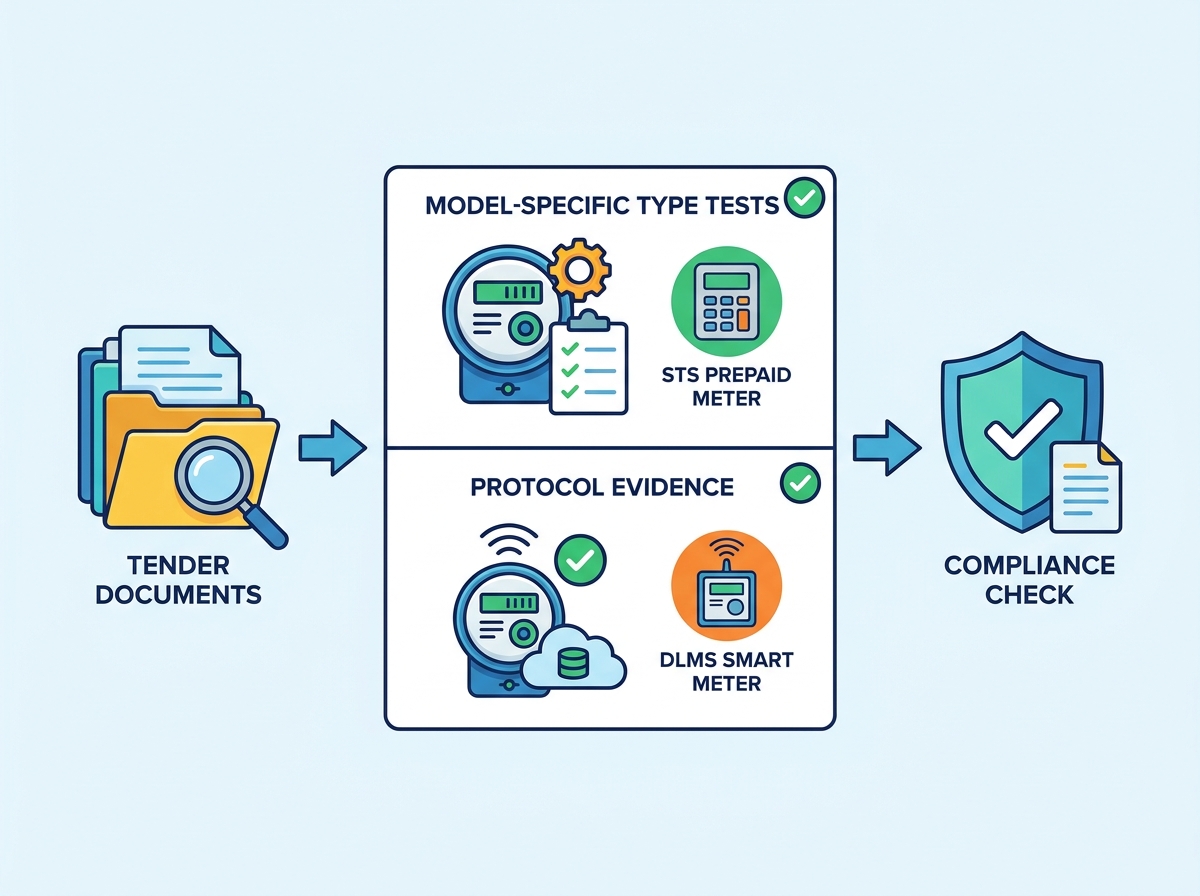
Protocol compliance directly dictates network interoperability. You must evaluate these features based on their ability to deliver true vendor-agnostic performance. Seamless integration with the Head-End System (HES) relies entirely on strict protocol adherence. Without it, utilities face isolated data silos, massive integration headaches, and the inability to switch software vendors in the future.
Vendors often claim DLMS compliance without official certification. Evaluators must cross-reference submitted certificates with the official DLMS User Association online registry. Navigate to the DLMS website and search for the exact manufacturer and model number. The registry provides undeniable proof of compliance and interoperability testing.
If the model does not appear in the registry, the certificate is likely forged or pending. Do not accept pending certifications for active tenders. The registry entry must display the exact hardware version and firmware build proposed in the bid. Any mismatch indicates the vendor modified the design after achieving certification, nullifying the interoperability guarantee.
Data security is paramount in AMI deployments. You must verify that the DLMS smart meter supports the required security suites. Suite 0 offers no security and is unacceptable for modern grids. Suite 1 provides basic authentication. Suite 2 delivers robust authentication and encrypted data transport using AES-128 GCM, protecting both data privacy and command integrity.
Demand cryptographic evidence within the tender submission. The vendor must provide documentation detailing their key management lifecycle. They must prove how cryptographic keys are generated, injected during manufacturing, and rotated in the field. Weak security profiles expose the grid to cyberattacks, data manipulation, and unauthorized remote disconnect commands.
DLMS certification alone remains insufficient for guaranteed interoperability. DLMS covers the application layer data structure. It does not guarantee the physical hardware can transmit that data across the network. Evaluators must also demand alliance certifications for the physical communication modules embedded in the hardware.
If the deployment uses RF mesh, demand Wi-SUN Alliance certification. For power line communication, require G3-PLC Alliance certificates. Cellular deployments utilizing NB-IoT or LTE-M must show compliance with relevant telecommunication standards. These communication layer certificates ensure the hardware will successfully connect to the chosen network infrastructure without dropping packets.
Grid requirements evolve constantly. Hardware must adapt without requiring expensive field visits. Demand documented proof supporting secure, verifiable OTA updates. The vendor must demonstrate how the device receives, authenticates, and applies firmware patches remotely over the AMI network.
OTA updates must never disrupt metrology functions. The device must continue measuring energy accurately while downloading the new image in the background. Demand test reports proving the dual-bank memory architecture functions correctly. If an OTA update fails or becomes corrupted, the device must automatically roll back to the previous stable firmware version to prevent bricking the unit.
Firmware dictates hardware behavior. Evaluators must perform a strict check regarding firmware versions across all submitted documentation. Ensure the firmware version listed on the DLMS certificate matches the version specified in the metrology type test. Both must match the exact firmware version proposed in the tender submission.
Vendors sometimes update firmware to fix bugs after completing type tests. However, significant firmware changes can alter metrological performance or protocol compliance. If the versions do not match, the utility cannot guarantee the proposed product performs identically to the tested sample. Demand a regression test report justifying any minor firmware discrepancies before accepting the bid.
Prepayment infrastructure requires specialized compliance checks. You must address these specific needs to prevent token fraud and ensure seamless vending integration. The entire revenue collection process relies on secure cryptographic token generation and validation. Flaws in this system lead directly to massive financial losses and customer disputes.
Validate Standard Transfer Specification (STS) compliance rigorously. Do not rely on vendor assurances. Check the submitted certificates against the official STS Association registry. You must specifically look for STS Edition 2 (STS600-4-2) certification. This updated standard handles the Token Identifier (TID) rollover event, which is critical for long-term functionality.
The TID rollover requires advanced cryptography to reset the base date of the token generation system. Legacy STS Edition 1 devices will reject new tokens after the rollover date. Ensuring Edition 2 compliance guarantees the hardware will continue functioning seamlessly. It also introduces enhanced security algorithms to combat sophisticated token forgery attempts and replay attacks.
Secure key injection processes form the backbone of prepayment security. Detail the evidence required to prove the vendor maintains a secure manufacturing environment. They must document how utility-specific cryptographic keys are loaded into the devices. This process must occur in a highly restricted, audited facility to prevent key leakage or insider threats.
Evaluate compliance with specific token carrier standards. Whether the utility uses numeric keypads, magnetic cards, or smart cards, the STS prepaid meter procurement process must validate the carrier interface. Demand test reports proving the keypad withstands millions of presses without failing. If using smart cards, verify compliance with ISO 7816 standards for secure contact interfaces to prevent physical degradation.
Hardware holds no value if it cannot communicate with the backend software. Vendors must provide comprehensive API documentation. They must supply integration certificates proving their equipment aligns with the utility's existing vending backend. Do not accept proprietary vending solutions that lock the utility into a single software ecosystem.
Demand proof of successful integration with third-party vending systems. The vendor should provide case studies or reference letters from other utilities demonstrating seamless API handshakes. This evidence ensures the utility can process transactions, generate tokens, and manage customer accounts without requiring a massive software overhaul or facing unexpected integration delays.
Procurement teams need a tactical checklist to identify discrepancies. You must actively mitigate the risk of fraudulent or inaccurate submissions. A structured audit framework removes guesswork from the evaluation process. It provides a clear, defensible methodology for shortlisting or disqualifying vendors based on hard evidence rather than marketing claims.
Begin by mapping the exact model number across all documents. Check the tender response, the metrology type test report, and the protocol certificates. Note the hardware version and communication module part numbers. Every single character must match perfectly across the entire submission package.
Vendors often use suffixes to denote different hardware configurations. A model ending in "-A" might have a different communication module than "-B". If the type test specifies "-A" but the tender proposes "-B", the submission is invalid. Any deviation is grounds for immediate clarification or outright disqualification. Do not assume minor naming differences are harmless typos.
Mass production must match the certified design perfectly. Audit the manufacturing facility's certifications. Demand current ISO 9001 certificates. This proves the factory utilizes standardized assembly and testing procedures, ensuring consistent build quality across thousands of units and minimizing out-of-box failures.
Information security is equally critical during manufacturing. Require ISO 27001 certificates for the production facility. The factory handles highly sensitive cryptographic keys and utility network credentials. ISO 27001 compliance ensures the vendor maintains strict access controls, network security, and data protection protocols to prevent credential theft during the assembly process.
Manipulated documents appear in tender submissions frequently. Check the document properties and metadata for recent modifications or suspicious author names. Look for visual inconsistencies in fonts, alignment, or digital signatures within the test report. Fraudsters often splice valid test results with uncertified model numbers.
Never rely solely on the provided PDF. Directly contact the issuing laboratory for confirmation. Send the certificate number and issue date to the lab's official verification email address. Reputable labs will quickly confirm the report's authenticity. This simple step eliminates the risk of accepting fabricated test results and protects the utility from legal liability.
Document checks only go so far. Structure the tender to require a "golden sample." This physical unit must match the certified documents exactly. The utility's engineering team will dismantle this sample to verify internal components, PCB layouts, and metrology chips against the type test schematics.
Follow the golden sample evaluation with rigorous Factory Acceptance Tests (FAT). Before authorizing mass deployment, send utility representatives or third-party auditors to the manufacturing facility. They must select random units from the production line using ISO 2859-1 sampling standards and subject them to accuracy and protocol tests. FAT ensures the mass-produced units perform identically to the golden sample.
Take the following actions to secure your next deployment:
Update current tender templates to explicitly mandate model-specific type test reports and forbid generic family certificates.
Integrate direct registry verification steps for DLMS and STS certificates into the standard technical evaluation workflow.
Require independent laboratory ILAC accreditation proof alongside all metrology and EMC submissions.
Establish mandatory golden sample teardowns and comprehensive Factory Acceptance Testing (FAT) before authorizing mass production.
A: A type test is a comprehensive suite of tests conducted on a representative sample. It ensures the specific hardware design meets stringent metrological, environmental, and safety standards like IEC or MID. These tests validate accuracy, electromagnetic compatibility, and physical durability before mass production begins.
A: You verify compliance by checking the exact model number and firmware version against the official DLMS User Association online database. The registry provides undeniable proof. If the proposed model and firmware do not match the registry entry exactly, the certification is invalid for that specific hardware.
A: A protocol certificate like DLMS covers the application layer data structure and formatting. A communication layer certificate, such as Wi-SUN or G3-PLC, ensures the physical hardware module can successfully transmit that structured data across the specific RF or power line network infrastructure.
A: A family certificate covers a broad range of generic designs and variations under one report. A model-specific certificate applies only to the exact hardware, component layout, and firmware revision being procured. Utilities must demand model-specific certificates to guarantee the delivered product matches the tested sample.
A: ILAC and ISO 17025 accreditation ensures the testing laboratory possesses the technical competence to perform specific tests. It proves they use properly calibrated equipment and follow impartial, standardized procedures. Reports from unaccredited labs hold no technical or legal validity in utility procurement.
A: Verify the submitted certificate directly against the official STS Association registry. You must ensure the hardware complies with STS Edition 2 (STS600-4-2). This specific edition guarantees the device supports the latest cryptographic algorithms and can successfully handle the mandatory Token Identifier (TID) rollover event.
A: Failure indicates the device lacks proper shielding or robust components. When exposed to electromagnetic interference, RF noise, or voltage surges on the grid, the unit may malfunction. It could record inaccurate billing data, drop network connections, or suffer permanent physical damage.


