


Views: 0 Author: Site Editor Publish Time: 2026-10-11 Origin: Site


Scaling Advanced Metering Infrastructure (AMI) introduces a critical risk for utilities: vendor lock-in. Without standardized communication and data models, integrating multiple meter brands into a single grid becomes technically and financially prohibitive. Utility decision-makers often face confusion when defining technical requirements for utility smart meter solutions. They frequently treat DLMS/COSEM and STS as mutually exclusive options. This misunderstanding leads to misaligned infrastructure. Utilities either lack the bidirectional data flow required for grid management or fail to secure their prepayment revenue streams.
Resolving this requires a clear technical evaluation of what each standard actually governs. This guide breaks down the architectural roles of DLMS/COSEM and STS. It explains how they address different layers of smart metering. You will learn how to structure your procurement requirements to ensure both interoperability and revenue protection.
Distinct Architectural Roles: DLMS/COSEM governs data modeling and bidirectional communication (interoperability), while STS strictly governs secure token generation and transfer (prepayment).
Complementary, Not Competitive: A DLMS smart meter can successfully encapsulate STS tokens; modern AMI deployments frequently utilize both standards to handle complex grid data alongside secure prepayment.
Infrastructure Demands: DLMS requires robust, always-on communication networks (e.g., NB-IoT, LoRaWAN, Cellular) and a centralized Head-End System (HES), whereas STS can function entirely offline via keypad entry.
Vendor Independence: Mandating DLMS/COSEM certification is the most reliable method to ensure a single HES can manage meters from multiple manufacturers.
The Device Language Message Specification (DLMS) and Companion Specification for Energy Metering (COSEM) form the global benchmark for smart meter interoperability. These standards dictate how metering equipment communicates with central systems. They provide a universal language for utility devices. This standardization allows grid operators to deploy hardware from various manufacturers on the same network. It eliminates the need for proprietary software silos.
A DLMS smart meter relies on these protocols to ensure data consistency. Utilities use this standard to retrieve billing data, monitor power quality, and execute remote disconnects. The framework guarantees that a command sent from the central server is understood identically by every compliant device in the field. When installing thousands of endpoints across a city, grid operators cannot afford to run five different software platforms for five different hardware brands. DLMS solves this fragmentation at the protocol level.
COSEM acts as the foundational data model for the meter. It packages internal meter data into standardized formats called objects. Everything inside the meter becomes an object. Voltage, current, active energy, and event logs all have specific object identifiers. This structured modeling means the central system always knows exactly where to look for specific data points.
Engineers use the Object Identification System (OBIS) to classify these data points. An OBIS code is a six-group hierarchical number that uniquely identifies every measurement or configuration parameter inside the meter. When the central system wants to read the total active energy, it does not ask for a generic energy value. It requests the specific OBIS code.
OBIS Code | Description | Data Type |
|---|---|---|
1.0.1.8.0.255 | Active Energy Import (+A) Total | Double Long Unsigned |
1.0.2.8.0.255 | Active Energy Export (-A) Total | Double Long Unsigned |
1.0.32.7.0.255 | Instantaneous Voltage (Phase L1) | Long Unsigned |
1.0.31.7.0.255 | Instantaneous Current (Phase L1) | Long Unsigned |
0.0.96.1.0.255 | Device Serial Number | Octet String |
DLMS functions as the transport protocol. It provides the messaging rules that move COSEM objects over the network. Think of COSEM as the cargo and DLMS as the delivery truck. The protocol defines how messages are formatted, encrypted, and acknowledged. It ensures that the data model remains intact during transmission from the endpoint to the utility server.
One major advantage of DLMS is its independence from the physical communication layer. The protocol utilizes specific adaptation layers to operate seamlessly across diverse networks. You can deploy it over NB-IoT, LoRaWAN, Power Line Carrier (PLC), or standard Cellular networks. The application layer remains completely unchanged regardless of the bearer.
This independence provides massive flexibility for utility deployments. A utility might use PLC in dense urban areas where meters are clustered in basement electrical rooms. They might use cellular networks in rural locations where meters are miles apart. Despite the different physical networks, the data model stays consistent. The central system processes the incoming data exactly the same way. Field technicians do not need to learn different data structures for different communication modules. They simply swap the communication module, and the DLMS protocol handles the rest.
DLMS enables a single Head-End System (HES) to manage the entire meter population. The HES executes standard services across different meter brands. These services primarily include GET, SET, and ACTION commands. A GET command retrieves consumption data. A SET command updates configuration parameters, such as changing the billing date. An ACTION command triggers specific functions like a remote disconnect or a firmware upgrade.
This interoperability delivers significant business value. It eliminates reliance on proprietary vendor software. Utilities no longer need to run multiple parallel systems to manage different meter brands. This consolidation streamlines operations, reduces software maintenance, and prevents integration bottlenecks during large-scale network rollouts. When a utility issues a tender for new meters, they simply specify the required DLMS profiles. Any vendor that meets those profiles can integrate their hardware into the existing HES without custom software development.
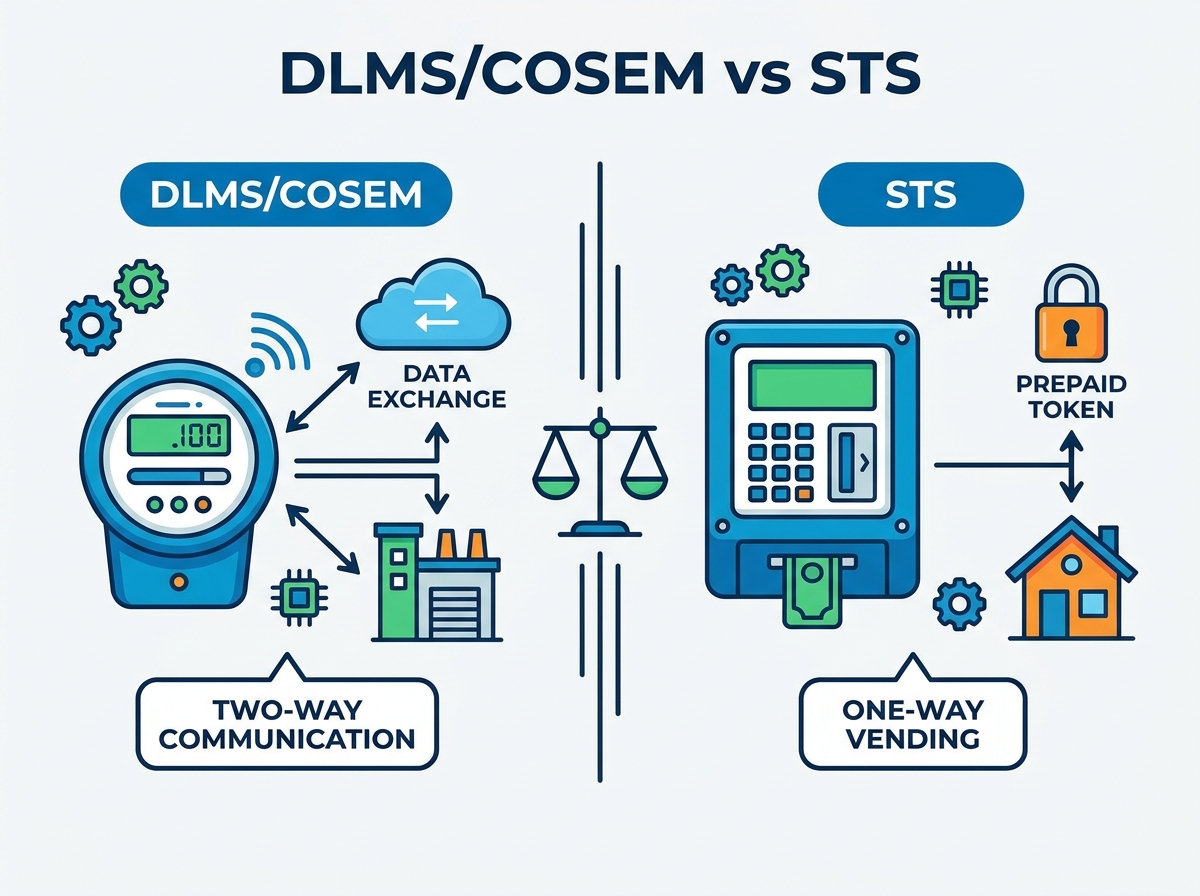
The Standard Transfer Specification (STS) serves as the global standard for utility prepayment. It governs the secure transfer of electricity credit and other utility tokens. STS focuses entirely on the transaction layer. It ensures that consumers can purchase utility credit from third-party vendors and securely load it onto their meters. The standard provides a highly secure, decentralized method for revenue collection.
STS operates independently of meter reading or grid analytics. Its sole purpose is revenue protection. The framework guarantees that generated tokens are unique, secure, and tied to a specific device. This prevents fraud, token duplication, and unauthorized credit loading. The International Electrotechnical Commission recognizes STS under the IEC 62055 series, cementing its status as the default prepayment protocol worldwide.
The mechanics of STS rely on strict cryptographic key management. When a consumer purchases credit, the vending system generates a 20-digit token. This token contains the credit amount, a unique meter identifier, and a timestamp. The vending system encrypts this data using a specific vending key.
STS prepaid meters hold the corresponding decryption keys. When the consumer enters the 20-digit token, the meter decrypts the payload. The meter verifies the token's authenticity and checks against its internal memory to ensure the token has not been used before. STS ensures that a token generated by a utility vending system can only be decrypted and accepted by the specific target meter.
The 20-digit format is highly structured. It includes a Token Identifier (TID) that tracks the exact minute the token was generated. The meter stores the TIDs of recently used tokens. If a user tries to enter the same 20-digit string twice, the meter recognizes the duplicate TID and rejects the token. This simple but effective mechanism completely eliminates replay attacks.
The historical advantage of STS is its offline capability. It enables revenue collection without requiring a persistent two-way communication network. Consumers can purchase tokens at local shops and enter them manually via a keypad. This makes STS ideal for regions with unreliable communication infrastructure. Utilities secure their revenue upfront without needing an active AMI network.
However, STS has evolved for smart environments. STS Edition 2 supports advanced cryptographic algorithms and facilitates remote token delivery. Utilities can now send STS tokens directly to the meter over an active communication network. This eliminates the need for manual keypad entry while maintaining the robust cryptographic security of the STS standard. Edition 2 also addresses the TID rollover event, ensuring meters can continue accepting tokens well into the future by updating their base dates through secure key change tokens.
DLMS focuses comprehensively on the communication layer and data retrieval. It handles complex grid data. This includes load profiles, power quality metrics, and detailed event logs. It standardizes how a utility talks to the meter to gather operational intelligence. DLMS is designed for two-way communication and grid management. It allows engineers to diagnose voltage sags, detect tamper events, and update firmware remotely.
STS focuses strictly on the application and transaction layer. It is built exclusively for revenue protection and credit transfer. It does not care about voltage sags, load profiles, or firmware updates. Its only job is to ensure that a purchased credit token securely reaches the meter and increments the available balance. It is a highly specialized tool for a highly specific financial task.
The security models of these two standards operate at different layers. DLMS utilizes robust transport-layer security. It employs DLMS Security Suites, leveraging AES-GCM encryption and authentication. This protects data in transit between the meter and the HES. It prevents unauthorized parties from intercepting or tampering with grid data as it moves across the network. The HES and the meter establish a secure session before any data is exchanged.
STS relies on application-layer cryptography. A Key Management Centre (KMC) manages the cryptographic keys. STS ensures that financial tokens cannot be forged or reused, regardless of how they are transported. Even if a token is sent over an unencrypted network, the STS cryptography ensures the token remains secure and valid only for the intended meter. The security is baked into the 20-digit payload itself, not the pipe carrying it.
DLMS is mandatory for modern grid analytics. Utilities need bidirectional communication for outage management and dynamic tariff updates. DLMS allows the HES to poll the meter at granular intervals. It provides the high-resolution data required for load balancing and detecting non-technical losses. Grid operators can pull 15-minute interval data to map exact consumption patterns across different neighborhoods.
STS has distinct limitations in this area. It is unidirectional by design. The vending system generates a token and sends it to the meter. The meter does not send data back to the vending system via the STS protocol. To achieve bidirectional data flow, STS must be paired with an AMI communication protocol like DLMS. Without a secondary protocol, the utility has no visibility into the meter's operational status until a field technician physically inspects it.
DLMS requires robust network infrastructure. Polling meters for detailed load profiles demands high bandwidth and persistent connectivity. The network must support frequent, large data payloads. This requires careful planning of cellular or RF mesh networks to ensure reliable data retrieval. If the network goes down, the utility loses visibility into the grid.
Traditional STS setups have a very low barrier to entry. They are offline-capable by nature. They require zero network infrastructure at the meter level. This makes STS highly resilient in areas with poor connectivity. The utility only needs to maintain the central vending system and point-of-sale terminals. The consumer acts as the data carrier, physically transporting the token from the shop to the meter.
Feature | DLMS/COSEM | STS |
|---|---|---|
Primary Function | Data modeling and bidirectional communication | Secure prepayment token generation and transfer |
Standardization Scope | Communication and data retrieval | Application and transaction layer |
Security Model | Transport-layer (AES-GCM encryption) | Application-layer (KMC cryptography) |
Network Requirement | Requires persistent, always-on connectivity | Can operate entirely offline via keypad |
Data Flow | Bidirectional (HES to Meter, Meter to HES) | Unidirectional (Vending system to Meter) |
A common myth in the industry is that utilities must choose one standard or the other. This is entirely false. DLMS and STS are highly complementary. You do not have to sacrifice grid analytics for secure prepayment. Modern smart metering projects frequently architect hybrid solutions that leverage the strengths of both standards.
In a hybrid deployment, DLMS handles the heavy lifting of communication. It manages the network connection, secures the data transport, and retrieves operational data. STS sits at the application layer, handling the financial transactions. This combination delivers the ultimate smart grid endpoint: a fully manageable device that also protects utility revenue. The meter acts as a standard DLMS node on the network, while internally running an STS decryption engine for credit management.
A DLMS meter can receive an STS token remotely without any manual keypad entry. This process relies on data encapsulation. The HES acts as the bridge between the STS vending system and the DLMS network. When a consumer buys credit, the vending system generates the standard 20-digit STS token.
The vending system forwards this token to the HES via a secure API. The HES then packages the STS token into a specific COSEM object payload. It transmits this payload using the DLMS protocol over the AMI network. The HES typically uses a DLMS ACTION request targeting the specific OBIS code designated for token entry.
Once the meter receives the DLMS message, it unpacks the COSEM object, extracts the 20-digit STS token, and passes it to the internal STS decoder. The decoder processes the prepayment exactly as if it had been typed on a physical keypad. The meter then sends a DLMS acknowledgment back to the HES confirming the successful credit update. This seamless integration provides the convenience of remote top-ups with the cryptographic security of STS.
Utilizing both standards allows utilities to manage highly flexible billing environments. Utilities can seamlessly switch consumers between postpaid and prepaid modes remotely. They do not need to change the physical hardware or dispatch field technicians. The HES simply sends a DLMS command to update the meter's configuration, altering the internal relay control logic.
If a customer defaults on postpaid bills, the utility can remotely switch the meter to STS prepayment mode. The customer must then purchase STS tokens to restore power. If the customer establishes good credit, the utility can switch the meter back to postpaid mode, relying on DLMS to retrieve monthly billing reads. This flexibility drastically reduces operational overhead and improves customer service. It allows the utility to adapt to changing economic conditions without stranding physical assets in the field.
Projects focused heavily on grid modernization should prioritize deep DLMS integration. If your primary goals are load balancing, loss detection, and complex time-of-use billing, DLMS is non-negotiable. You need the granular data that COSEM objects provide. You must ensure your HES can poll meters every 15 minutes to generate accurate load profiles.
In these scenarios, focus on communication bearer reliability. Ensure your chosen network can handle the data volume required by frequent DLMS polling. Validate that your HES supports the full suite of DLMS services necessary for advanced grid analytics. Pay close attention to the meter's memory capacity, as storing high-resolution load profiles requires significant onboard storage.
Projects operating in areas with high non-technical losses must prioritize STS. If your consumer demographic is largely unbanked, or if your communication networks are highly unreliable, STS is the safest choice. It guarantees revenue collection regardless of network status.
In these environments, offline capability is a massive asset. Even if you deploy smart meters, ensure they have physical keypads. If the AMI network goes down, consumers must still be able to enter STS tokens manually. This fallback mechanism prevents revenue stalling during network outages. Train your field teams to verify keypad functionality during the initial installation phase.
Deploying these standards carries specific implementation risks. You must actively manage these risks during the procurement and rollout phases.
Certification Verification: Vendors often claim compliance without holding official certification. This leads to severe interoperability failures. Always demand official DLMS User Association (DLMS UA) certification for all proposed hardware.
Network Latency Alignment: DLMS polling frequencies must match the bandwidth limitations of your communication bearer. Pushing high-frequency DLMS polling over low-bandwidth networks will cause network congestion and packet loss. Align your data requirements with your network capabilities.
Integration Complexity: Aligning a multi-vendor DLMS rollout with a legacy STS vending system introduces hidden costs. You must build custom APIs between the vending system and the HES to facilitate remote token delivery. Budget for this integration work upfront.
Security Overhead: Managing dual cryptographic frameworks requires strict governance. You must maintain DLMS security suites for data transport while simultaneously managing STS key management for financial transactions. Ensure your IT teams are trained on both security architectures.
To ensure a successful smart metering rollout, utilities must move beyond treating communication protocols and prepayment standards as competing technologies. Integrating DLMS for robust data transport and STS for secure revenue collection creates a resilient, future-proof grid architecture. Implement the following steps to align your procurement strategy with these technical realities:
Audit your current HES capabilities to ensure it supports both DLMS polling and STS token encapsulation via API integration.
Require proof of official DLMS UA and STS Association certifications from all shortlisted vendors during the initial procurement phase.
Conduct a limited field pilot testing remote STS token delivery over a DLMS connection before committing to a full-scale rollout.
Evaluate your communication bearer bandwidth to confirm it can support the required DLMS data payload sizes without excessive packet loss.
A: COSEM is the data model that standardizes how meter information is structured into specific objects. DLMS is the communication protocol used to transport that structured data across a network. Together, they ensure devices speak the same language and format data consistently for the central system.
A: Yes. A DLMS meter can function as a prepaid meter if it is equipped with an internal disconnect relay and programmed to accept prepayment tokens. Utilities often use the STS standard encapsulated in DLMS messages to securely manage these remote credit updates.
A: The HES acts as the central management server that translates utility commands into DLMS protocols. It securely polls data, updates firmware, and manages configurations across thousands of interoperable meters from a single platform, eliminating the need for vendor-specific software.
A: No. Traditional STS meters can operate entirely offline via manual keypad entry. However, modern smart STS meters can receive tokens remotely via cellular, PLC, RF, or IoT networks using data encapsulation, providing flexibility for different deployment environments.
A: By standardizing the language and data structure meters use to communicate, DLMS allows utilities to purchase meters from multiple competing manufacturers. Grid operators can manage all these different brands through a single, unified software platform without custom integration work.


